Abstract
This piece proposes a symbolic reinterpretation of Kukulkán from an anthropological perspective, evaluating its role within the ritual and cosmological structure of the pyramid. It asks whether the descent of the "feathered serpent" represented not only an astronomical phenomenon, but also a socio-political mechanism for legitimizing power. It draws on archaeological, mythological and ethnohistorical evidence.
The question
The pyramid of Kukulkán has been widely read as a temple with an astronomical (mostly night-time) function. But could that phenomenon have been mis-read — and also carried a deeper socio-cultural function in the Maya worldview?
The hypothesis
In Maya, the word t'aan is polysemantic: one term holds different meanings by context. Kan means serpent (also four, yellow, and by extension South); kukul, depending on context, can mean wave or ripple of water; while "feathered" is said k'uk'um. So "Kukulkán" need not translate to "feathered serpent."
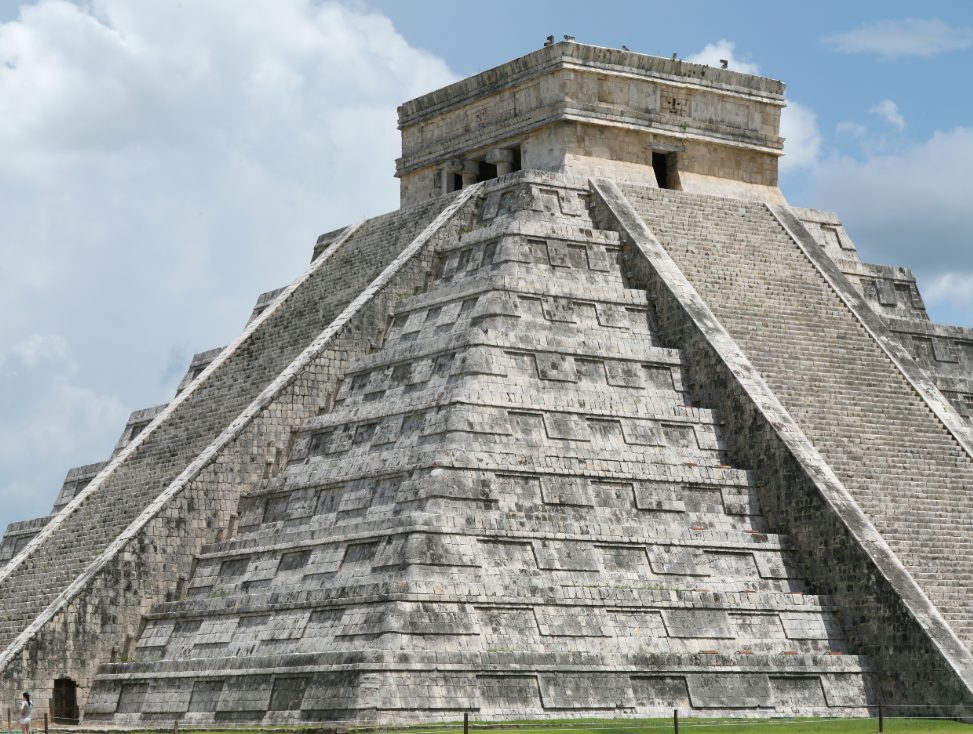
The proposal: the "descending serpent" is a way to explain the physical phenomenon of motion in a wave, coming from the supreme solar being — using the serpent's movement to describe it, describing the reflection of the sun on water waves at dawn and dusk. Notably, every level and face of the pyramid reflects clear (square) waves, using the serpent as a reference to explain the phenomenon, not the other way around.
Sources
- Dr. Enrique Florescano (1937–2023) — Quetzalcóatl as a myth formed from many myths; Kukulcán traced to three paragraphs of Fray Diego de Landa's Relación de las cosas de Yucatán.
- Spanish–Maya dictionary of Javier Abelardo Gómez Navarrete (UQROO).
- Cogolludo (1971) on the Kukulcán idol — referenced by him alone, without corroborating testimony or evidence.
- Electromagnetic properties of the Great Pyramid — doi.org/10.1063/1.5026556.
Rescued from the original clonick.com page. The original hotlinked an external image (acordesweb.com); it will be replaced with an owned asset in the migration.